Sunday, February 10, 2019

Is It Time to Marie Kondo Your Family History?

I believe it's safe to say that genealogists are hoarders. We save every old photograph (even those of people we can't identify), diaries, autograph books, letters, documents, family heirlooms, receipts - anything and everything we can get our hands on that were once touched by an ancestor.

When I started The Organized Genealogist Facebook group several years ago, it was obvious that we all have a problem with not only too much stuff, but what to do with that stuff. When I left my position as group administrator a few years ago, there were about 22,000 members. I see that it is now more than 31,000 members. That's a lot of people with a desire to find ways of dealing with stuff.

Yet how does one resolve our obsession with our hobby with our desire to downsize, minimize and declutter our lives as we grow older? I'm quite certain that the majority of people reading this post will respond with cries of Outrageous! No Way! How could I ever get rid of any of my precious family history?

On the other hand, there's a few of us who have reached the point of wanting to move on.

When enough is too much
During the years I spent as caregiver for my father, my free time was mostly restricted to doing online family history research. I moved my research findings ahead a lot in that time, just with information available on line. On Monday mornings at work when I was asked how I spent my weekend, my standard response was "Hanging out with the dead relatives." Even after I retired six years ago and after my father's death, I continued my obsession with the family history search as well as giving lectures and teaching about genealogy.

After a while, a switch was flipped. After 10 years of caregiving I found I had the opportunity to live my own life again. I began traveling for leisure once again after many years of traveling only for work. I was able to reignite my passion for music and theater and begin attending performances again.

I discovered I was tired of spending my free time hanging out with the dead relatives. I wanted to experience the joy of living my life my own way, meeting new people and having new experiences.

With that shift, I've slowly come to the realization that I no longer want to be burdened by my ancestor's Stuff. What once seemed like the Holy Grail of family history turned into my home becoming the repository for my ancestor's Junk. Stuff. Crap. It was suffocating me and my home. 

Before you gasp in panic, no, I haven't thrown it all away - yet. I'm just approaching it all much differently. That's where the Marie Kondo approach or the Minimalist movement enters the picture. Do these items spark Joy? Unlike 15 or 20 years ago, not so much.

My Family Heritage Center is still intact.
As I experience the process of downsizing my genealogy and family history research, I am aware of my desire to leave behind information and artifacts for future generations. I've decided that I am only taking my research back to the immigrant ancestors. I'm approaching my documents and photographs as an archivist, first by digitizing the paper items and then organizing them into physical folders and paper reports that will make sense to a future researcher. Heirlooms will be photographed using my Shotbox before I find a new home for them. I continue to explore options for the best archive, library or museum willing to accept the documents. It's also my intention to print my charts and stories into a format that I can assemble into a book - nothing fancy, just something that can be photocopied, printed and bound. Those books will go to the appropriate genealogy libraries in the ancestor's home counties. I'm also committed to including scans of documents and photographs in my public tree on Ancestry.

I'm the last living member of my immediate family and no known cousins have expressed any interest of becoming caretakers of the family history hoarder mess. I do want to leave behind a trail of bread crumbs that future researchers will be able to use as a starting point for their own research. 

While I continue to have an interest in family history, I've turned into a dabbler rather than an avid researcher. I can still spend hours going down the rabbit hole based on a clue I've found on a newspaper site. But, as has happened with my obsession with other hobbies over the years - a photography darkroom, tennis, golf, needle craft, etc. . . . the passion that sparked Joy is no longer there. I much prefer being out among the living once again rather than hanging out with the dead relatives.

Your mileage may vary.

Sunday, April 10, 2016

Create Your Own . . . Clip Art

Copyright issues sometimes plague genealogists and the family historian. This is especially true if we plan to publish our stories and research findings. Who owns the copyright for an image? When does an image belong in the public domain? Just because you own a photograph of your ancestor, does that mean you own the copyright to that image? The purpose of this post is not to address those issues. Instead, I refer you to Judy Russell's blog, The Legal Genealogist. She's the expert in topics relating to copyright and genealogy.

Instead, I want to provide some ideas for creating your own images for which you will own the copyright. Since most of us carry a smartphone all of the time, or have some kind of a point-and-shoot digital camera, creating your own images becomes pretty simple. You have to think Image. Think Graphic. Think Composition.

In college, I studied both photojournalism and art photography and have been an amateur photographer ever since. When I lived at home, my Dad even built me my own darkroom in our basement. I don't miss the smell of those chemicals contained in a small space and I'm so glad we have moved into a digital world. But ever since I was a youngster, I've seen my world inside of framed images. I'm always thinking, "how I can best compose a photograph of this subject?" Most of the time, I have a digital camera with me, but I ALWAYS have my iPhone to capture those spur of the moment shots.

I enjoy traveling, sightseeing, visiting museums and historical landmarks. Not only do I try to capture the typical "tourist" photos, I also have an eye toward what will make an interesting photograph to enhance a blog post, article or other published piece I might write about my ancestors. Over the years, I've created a fairly extensive library of photographs that I can enhance through photo editing software or apps. I can use them freely because I own the copyright since I took the photographs.

Everywhere you go, always think "Clip Art Library" and before long, you will have your own source of images for blog posts, articles, and family history books. Once you begin accumulating your images, you will need to organize them within folders on your computer and perhaps tag them with subject matter such as pioneers, flags, prairie, homestead, etc.

The following are a few of the images that I've captured in recent years. I hope they will inspire you to begin your own clip art library of images for which you own the rights and can use freely.

This one isn't all that exciting, but we are always writing
about libraries, archives and research.
So add a few shots that you've taken while visiting a library.
This is the cabin on the grounds of Homestead National Monument.
I've used variations of this which I've created in photo apps to make it look like a sketch,
a pencil drawing or a sepia print. I've used this one a lot!

Here's an example of a pretty boring photograph of one of the displays at the Leonardo DaVinci
exhibit that I shot at Union Station in Kansas City last month.
See the next photo for an example of how to make your photos go from ordinary to extraordinary.
This photo is composed with much more interest, focusing on the work table.
Same space, different perspective.

What might have been in the covered wagons our ancestors drove
as they moved westward in the 1860s? Here's an example I discovered at
the Pony Express Museum in St. Joseph, Missouri.

I haven't used this image yet, but can't we always use a reference to a compass?
Photo taken at the Lewis and Clark Center near Nebraska City, Nebraska.


I've used this image when writing about my Irish immigrant ancestors.
Photo taken at the Kansas City Irish Center when it was located at Union Station.

I took this photo yesterday at the Durham Museum in Omaha.
It was formerly the Omaha Union Station.
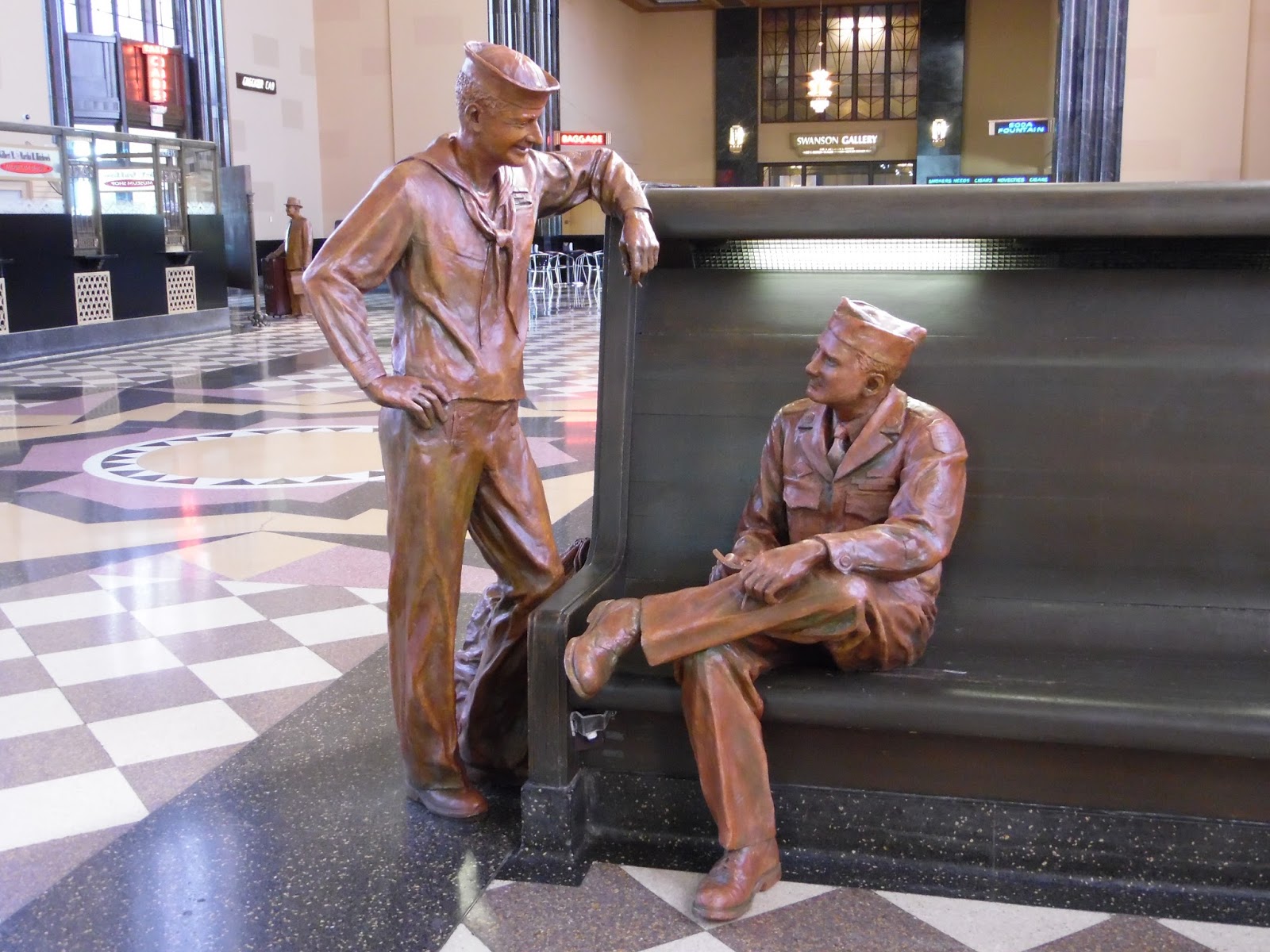
Sometime when I'm writing about my family members who served
in World War II, this is an image I can use.

Here's another example of a not very interesting straight-on shot.
See below for better composition.

This view is more interesting and I can use the
space on the right to add some typography, a quote or meme.

Example of a One Room School - establishing shot.
Durham Museum - Omaha

Then go for the special interest shot.
Durham Museum - Omaha

Wyuka Cemetery - Lincoln, Nebraska
This is one of my favorite views at Wyuka.
And here's how I turned that image into a sketch using an iPhone app.


My Mother's Hand
This is a recently discovered photo that I took of my Mom's hand with a family
Bible and some ancestor's glasses (no idea who!).
This was among a huge collection of negatives of photos I took while in college.
What a treasure for me to find this one!

With some simple apps, you can convert old images into interesting graphics.

Having fun with ancestor photos.
With photo apps, you can create collages and memes.

This is an old photo scanned from a negative.
It could still use some enhancing in Photoshop Elements.
Arthur Cemetery, Arthur, Nebraska.

Boot Hill Cemetery, Ogallala, Nebraska
I thought this view was much more interesting
than shooting from the other direction.
I've actually reversed it for a project so that it doesn't read backwards.
I'm a flag geek. I always take photos of flags flying at the sites I visit.
This is at the Museum of Danish America in Elk Horn, Iowa.
These are just a few examples of keeping your eyes open for Photo Ops. With digital photography, we are no longer restricted to 36 images per roll of film. Shoot photos to your heart's content. Even now, with no restrictions, I still feel as though I never take enough photos! Although, my Facebook friends and followers on Instagram may argue with me on that!

Here's a few more tips:
  • Take an establishing shot. Get the big picture. This is especially true when photographing cemeteries. Don't just take the photo of your ancestor's headstone. Get a wider view of the entire plot and area.
  • Take a photo of identification information. If it's a museum or gallery, take a photo of the sign that shows the hours of operation. Always take pictures of the historical marker that describes the site you are visiting. You may not end up using these in your project, but it's a good point of reference.
  • Take shots from several angles. Get your establishing shot, then shoot from the right, shoot from the left, zoom in. Look for interesting patterns, shadows and light. With digital, you can afford to take as many photos as you want.
  • Experiment with portrait and landscape and square. Use what suits your purpose. Since becoming hooked on Instagram, I shoot a lot of square photos (even though Instagram now allows other formats). You're not going to be shooting the inside dome of a state capitol building using landscape! If you are photographing art or exhibits in a museum, get a photo of the sidebar description of the piece. Again, that is for your reference, not necessarily something you will publish. It's akin to "citing your sources."
  • Start thinking in pictures, images, graphics. Think how you might be able to use a photograph of what you are seeing.
  • Look up. Look down. Perspective gives you a variety of images. A few months ago, I posted a collection of photographs I had taken of my hometown in the 1970s (I'd been binge scanning old negatives). A friend who is an art major/photographer commented that he had never seen our city in quite the way I had captured it. It's because I was looking up and looking down.
  • It is not possible to take too many photos!
  • Make sure you organize your collection. As mentioned earlier, add metadata to your image file that has tags so you can easily find what you're looking for.
  • Flags are always good subjects. Or maybe it's just me. I always tend to take photos of flags flying over whatever site I'm visiting.
Some IOS (iPhone/iPad) apps I enjoy using to enhance my photos include:
There are thousands to choose from! Keeping playing and experimenting and you can convert your photos into a variety of creative graphics.

Saturday, January 30, 2016

A Danish Day in Elk Horn, Iowa

I have a relatively (ahem!) long list of genealogy road trips on my wish list. Many of them are one-day trips and yesterday I was able to visit the Museum of Danish America in Elk Horn, Iowa. If you have even an ounce of Danish blood in you, this is a museum and community you must visit as part of your genealogy journey. Elk Horn is a community of 662 people as of the 2010 census. It's about a two hour drive from my home in Lincoln, Nebraska, so I have been waiting for a warmer and sunny day to make the trip. My genealogy pal, Judy Shutts of Voices in Time, is always eager for a road trip and we were both ready for a getaway.

We left Lincoln about 8 a.m., which seems to come way too early since I've been retired. This month marks the third anniversary of my retirement from public service with the state of Nebraska. Wow, how time flies! That put us into Elk Horn about 10 a.m. and our first stop was the Museum of Danish America.

The Museum of Danish America
With the cold Iowa wind blowing, it was a bit chilly, so we quickly got some exterior photos of the museum as we left.

I'm looking forward to a return visit during warmer weather so I can see the 30 acres of prairie surrounding the museum in the Jens Jensen Prairie Landscape Park. I'm sure it will be an amazing experience, as compared with the windy 40 degree temperatures we experienced yesterday!


I really didn't have a huge expectation of what information I might discover about my Danish heritage. Mostly, I wanted to learn more about what motivated my people to immigrate to America. My Danes are the only line of my heritage that I've been able to track "across the pond" - mainly due to the exceptional census records available on the Danish Demographic Database. Because of these records, I've gone back to my fourth great grandfather, Povel Madsen, in the 1700s.

The flags of Denmark and The United States
of America fly proudly outside the museum.
It was pretty exciting a few years ago when I found my ancestors on a passenger list on Ancestry.com. One must always think outside the box when doing genealogy. My family came to the U.S. via Canada with the intent of settling in Waterloo, Black Hawk county, Iowa. Based on what I know about migration patterns, I still assume that there must have been someone they knew who had already come to Waterloo - or some reason that they knew that was where they were headed. I didn't get the answers on this research trip, but it continues to be one of the questions I'm pursuing in tracking my family from Denmark to the United States.

The Museum of Danish America is a wonderful museum dedicated to the Danish in America. The exhibits are well curated and provide a lot of history about the Danish in America. I often have the tendency to rush through the museums I visit, but I took my time in reading the explanations about immigration - I really wanted to learn more about why my ancestors came to the U.S. when they did.

Choosing a New Land
These explanations at the museum provided some background on what motivated the Danish to come to America.

The lower level of the museum includes a glass enclosed case of many family heritage artifacts, including the iconic blue plates (we had a few of these in the family at one time), knick knacks, musical instruments, china and household items, items specific to the Danish Brotherhood of America. There was no public access to view the items in the collection close-up. I imagine that it might be possible to observe these under the supervision of museum staff. I didn't ask.


The "cocoa set" that belonged to
my great grandmother Caroline Petersen
Among the heirlooms passed down to me is what my Dad referred to as a "cocoa set" which may also be called a "chocolate pot." It includes a tall pitcher, a bowl, four cups and four saucers. I currently display this set in my "family heritage center" in my home.

Judy and me at the museum
Here's a composite photo I made for Instagram of Judy and me at the museum and the signs at the genealogy center which is on Main Street, a couple blocks from the museum.

After our visit to the museum, we had lunch at Larsen's Pub. I only had to see that one could have a burger with Havarti cheese to know what I wanted for lunch! That's been one of my favorite cheeses for a long time, and knowing it originated in Denmark made it even more special.

After finishing lunch, Judy asked the proprietor where the genealogy center was located. This was a pretty good question in a small community. Immediately, he replied, "Right next door!" Wow. We didn't even have to move the car!

An afternoon of research

As mentioned earlier, I didn't have a lot of expectations of what I might find at the genealogy library. I had taken along some printouts of family group sheets with the information I have collected on this line of my family history. As an afterthought, I tossed my Kindle Fire in my bag, with the Ancestry app. Several times I had to refer to my family tree to get specific information on names and dates.

The ladies in the library were extremely helpful. As I read through books on Cedar Falls, Iowa and Black Hawk county, I found some information about what attracted the Danes to this part of America. It was the kind of information I had been looking for. After a while, the ladies showed me the original documents from Denmark they had discovered about my family! Not only had they found birth, baptism and marriage records, but also photographs of the churches where the baptisms and marriages had occurred. Part of the service they offer to researchers is to transcribe the Danish records into English. I really felt I had hit the mother lode of family history research! To say that I did the "Genealogy Happy Dance" is an understatement!

These are the original documents (in Danish) that the staff printed
and translated for me, as well as photographs of the churches
where the baptisms and marriages occurred.
I found this death record information about my 2nd great grandfather,
Peder Jeremiasen, in a book published by the Iowa Genealogical Society.
I didn't want to be on the road too long after day turned in to night, so we left the library about 4 pm. We still wanted to visit the Danish Windmill, so we stopped there on our way out of town.

The Danish Windmill


Danmark Sweatshirt and
some Carlsberg Elephant Beer

I've been wanting to get a red sweatshirt (without Go Big Red on it), and I found this at the Danish Windmill. I've never had Danish beer before, so I bought a six pack of Carlsberg Elephant Beer. The taste is quite similar to Corona. You've got to have Danish beer at least once in your lifetime!

What can I say? It is SO COOL to go somewhere where they know that your surname is spelled with "sen" rather than "son." !!! Rock On!

Kudos to Michele at the Museum of Danish America library for her exceptional help and the translations, and teaching me how to pronounce Jeremiasen properly! And to the other ladies who helped with my research yesterday. Yes, I will definitely be back! And today, I submitted my payment for membership to support the museum. Yesterday's Genealogy Road Trip far exceeded my expectations!

Michele asked to photocopy my Family Group Sheets so they could begin a file on "my people." It was a no brainer for me to oblige. I plan to compile a binder of the information I've gathered so far, with printouts and copies of documents. I want to leave behind some bread crumbs on my family line for future researchers.

I always thought that my Danish line would be the most difficult to track because of the patronymic naming system - changing surnames with each generation. Who knew that it was going to be the easiest and the first of my ancestral lines I would find "across the pond"?

Sunday, August 30, 2015

Genealogy Synchronicity - Tibbetts home in St. Joseph, Missouri

Dare I say we are fools if we don't believe in Genealogy Synchronicity?

Last week, I had an experience that can definitely be described as Genealogy Synchronicity!

Back in 2011, I wrote about discovering the obituaries and death records for Nellie Welch Tibbetts and her husband, Frank Tibbetts. Nellie was the sister of my great grandmother, Mary (Minnie) Welch Kelly. I had discovered photographs of the home where Nellie and Frank lived in a photo album that belonged to my great grandmother.

The Tibbetts home in St. Joseph, Missouri


I've made several trips THROUGH St. Joseph, Mo in the last two years. It wasn't until last week that I spent an entire day in St. Joe and my last stop of the day was a "drive by" to finally see the Tibbetts home.

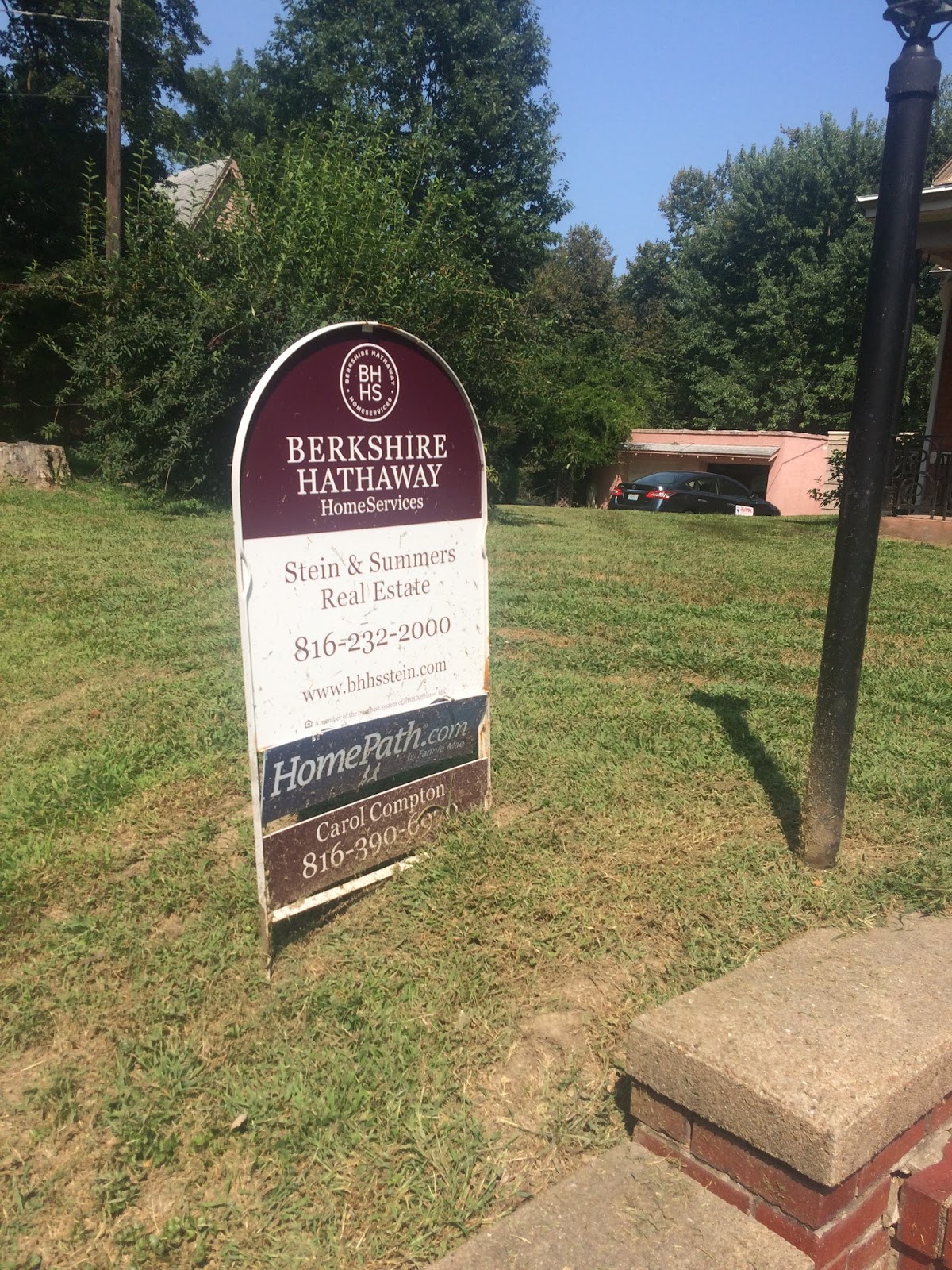
As I pulled over to park my car, I saw that the house is currently For Sale!


This was exciting to me, as it meant I would be able to take some photographs without the current owner wondering what the heck I was doing there!


I walked around the property, taking a few exterior photos, when, after a few minutes, a young man exited the front entrance and said Hello!

He happened to be the realtor for the property and he had just arrived at the location!

"Have I got a story for you!" I said! I told him that the house had been owned by the sister of my great grandmother and her husband in the early 1900s. I told him that the owner of the house at that time, Frank Tibbetts, had been a brick mason! The realtor told me that is father is a brick mason!

I brought up the photos of the house, including members of my family, to show him, on my smartphone. Yeah, he was pretty impressed! He told me the house was a foreclosure. And I was able to enter the property to look around.

Here's a photo from Minnie Welch Kelly's photo album taken at the house. I believe the women to be Nellie Welch Tibbetts and her sister, Agnes Welch Garrigus. The "porthole" window at the house is a good indication of where the photograph was taken.


This photograph is taken from the interior of the house. The windows match up with the photographs in Minnie Welch Kelly's photo album.


Here's the fireplace inside, which is probably original to the house.


This is one of the windows looking to the South. My speculation is that the "stained glass" is not original to the home.


These are the stairs to the upper floor of the house. They do not appear to be the original finishing, but quite possibly were there when the Tibbetts lived here.


This is one of the windows, facing South. Quite likely original as seen in the photos in Minnie Kelly's photo album.


As the house is currently vacant, I feel it is acceptable to post the current "for sale" information on the property. The asking price is $63,000.The photos on the real estate site show a home that looks much better than it does "in real life."

For me, I'm just glad that I made the decision to stop by when I did. How often do you really get to look inside a house where your family lived???

Sunday, July 5, 2015

The Deep Internet - Learn how to make use of Database Searches


Genealogy Research in the Deep Internet

Join me in Omaha on July 18 when I show you how to find hidden treasures online in the "Deep Internet." Did you know that at least 80 per cent of genealogy information online cannot be found using a standard search engine such as Google? Are you missing out on 80 per cent of information you can find out about your family online?

If you've been frustrated with the results of your searches on Ancestry, find out how you can improve the way you search by using some adjustments to the way you think about search strategies!

This presentation is Free and open to the public. But you need to preregister here:


July 18, 2015
2:00 p.m. - 3:00 p.m.
W. Dale Clark Library
215 S. 15th St
Omaha, Nebraska

Wednesday, July 1, 2015

My Nebraska - by Patricia Landon Kelly Petersen

Today I came across a long lost poem written by my mother, Patricia Landon Kelly Petersen, in 1968. This poem was also very special to me and it was read at her memorial service in 1983.


My Nebraska

Oh, you'll never know Nebraska
'Til you've seen her in the Spring,
Awakened by a gentle rain
And hear the robins sing.

Every green and growing petal
Has its face washed, oh, so clean.
If you've been here in Springtime,
You'll remember what I mean.

Oh, you'll never know Nebraska
'Til some summers you have spent
To hike, to swim, to fish, to sail
Or just be quiet and content.

If you've never heard the wind blow
Through those cottonwoods so tall,
You don't know what you're missing,
That's my favorite sound of all.

Oh, you'll never know Nebraska
'Til you've felt her winter cold,
Shared one of her White Christmases,
It's a splendor to behold.

And to see the little children
Bundled up from head to toe.
They ignore my shoveled pathway
To wade the deepest snow.

Oh, you'll never know Nebraska,
Come see her in the fall.
Then she really shows her colors
With the kindest touch of all.

I can taste that first ripe apple.
I can smell that bonfire now.
If I could ever be more blessed
I wish you'd tell me how.

And did you ever go away?
Get so homesick you could cry?
If I tell you that I haven't
Then I'm telling you a lie.

I wonder if you've played this game
When you're returning home,
To see who can be the first to spy
That long familiar dome.

copyright 1968 Patricia Landon Kelly Petersen

Friday, May 29, 2015

Ancestry and Family Tree Maker - Why I Am Bass Akwards

Once again, the rumors have surfaced that Ancestry.com is up for sale. As happens with such rumors and announcements, the genealogy community is all aflutter, scared silly that everything they have added to their family tree on Ancestry is about to disappear.

Maybe I have more confidence in online sites than others. From participation in many online genealogy forums, I've arrived at the conclusion that I use my software and Ancestry web site differently than most.

Ancestry.com at the conference of the
National Genealogical Society
St. Charles, MO 2015

I've gathered that people using Family Tree Maker (FTM) software enter all of their data within the software and perhaps sync it with their tree(s) on Ancestry. I do just the opposite. I enter all of my discoveries directly on the Ancestry site. Every few weeks (or months, if I get behind), I download the GEDCOM from Ancestry into my FTM software. I consider the FTM GEDCOM download as a backup of my research.

Am I lazy? Do I like living life (and my research) on the edge? I don't know. All I know is that this is what works for me.

I'm pretty much a digital kind of gal. And I know that may subject me to some dangers. I have my scanned images of documents and my personal digital photo archive all on my laptop with a backup to the cloud via Dropbox and my Amazon photo cloud. Have I thrown away or discarded any of my original documents, photographs, scrapbooks, slides or negatives? Not on your life! It's just easier for me to manage all of the data in a digital archive.

I think that we all like what we are used to. That is why I prefer OneNote to Evernote (although I use both). I prefer Family Tree Maker to Roots Magic and Legacy. Why? Because it's what I'm used to. In my working life, I always used the analogy: the only person who likes change is a wet baby! The same is true with genealogy and our software.

The advantage of being able to download a GEDCOM from Ancestry is that I can import it into whatever software application I'm using. Each of the major software packages provides different options for reports, printouts, books, etc. Having been 100% digital for several years, I'm just beginning to recreate hard copies of my research using the various software applications. Each one allows me to have different options, printouts, etc.

Am I concerned about an impending sale of Ancestry? Not so much. Do I fear that all of my research will be lost? No. Why? Because I have my GEDCOMS, my scans, my notes, my boxes and boxes of documents and photographs. And everything is backed up - on my laptop, Dropbox, Amazon, as well as on external hard drives.

For now, Ancestry remains my online tree of choice. The online family trees on Ancestry are excluded from my routine searches. I think we all know how unreliable so many of them can be. But I know they are there if I need a few hints. FamilySearch provides me with additional resources, but there is NO WAY I'm going to get into a discussion of sources or "who's right and who's wrong" in entering data or citing sources. The best I can do is to make my research available for future researchers, with source citations. I'm not going to get this all done in my lifetime, but I can leave some bread crumbs for those who choose to follow my research in the future.

Seriously, who really knows if Ancestry will be around in 100 years? I sure don't. FamilySearch-LDS - definitely a good chance of survival. Who know if the Internet will even look the same in 100 years? All I know is that I will continue to do my data entry on Ancestry, with my back-ups to FTM.

At this point in my life and research, my objective is to produce as much as possible into "hard copy" that can be printed/published and donated to local societies and libraries for those family members and historians who come after me.


Join Me in Searching the Deep Internet!

I've cut back on my speaking engagements this year while I pursue some education, classes and genealogy conferences for my own personal growth and development. However, I remain committed to the Omaha Public Library's (OPL) summer sessions and I'm always thrilled to be invited back! This summer marks my fifth speaking engagement at OPL as part of the genealogy series in the summer reading program.


On July 18, I'll be speaking about the "Deep Internet" and the various web sites you need to be searching to find information about your ancestors. Google doesn't do it all and there are other web sites where genealogy information can be found. You can think of this as a Scavenger Hunt - or "Nebraska Jones" on a vast treasure hunt for family history information!

I'm still in the process of creating this presentation and I'm excited about the adventures we will share together!

July 18, 2015
W. Dale Clark Library
215 S. 15th St
Omaha, NE
2:00 pm - 3:00 pm

Register here

It's Free! So reserve your space today!

Why I Love Newspapers.com

I subscribe to three paid newspaper subscription sites: NewspaperArchive.com, Genealogybank and Newspapers.com. As a journalism major in college, I had always been something of a news junkie until recent years when all of the "bad news" in the media made me cancel my newspaper subscriptions and stop watching TV news. You know the saying, "If it bleeds it leads." But I still feel as though printer's ink runs in my veins and I absolutely love Love LOVE old newspapers for my genealogy research.

The team from Newspapers.com at the recent conference
 of the National Genealogical Society in St. Charles, MO.
I HAD to stop at their booth to tell them how much I LOVE the site!

Comparing the Big Three

Over the past thirty or so years of genealogy research, I've had on-again off-again periods of being active. In one of my off-again periods, I subscribed to NewspaperArchive and I was searching non-genealogy topics. It became a valuable resource for me once I returned to family history research. That is, until they discontinued carrying images from some of my favorite newspapers because of the end of some licensing contracts. Even with their increase in fees (close to $200/year now, billed every six months), I've maintained my subscription because I continue to find articles about long lost relatives within their pages. Compared to the other sites, I believe their pricing is too high, but I've found enough information there to justify the expense.

GenealogyBank is also a favorite newspaper subscription site and it also includes more contemporary obituaries which has moved my research forward considerably by examining the lists of survivors. The annual cost for new subscribers is about $70. Monthly subscriptions are available. You can also get a 30-day trial for under $10.

Whenever anyone asks about which paid site is the best, my answer is always "Whichever one has the most newspapers in the area where your ancestors lived." That being said, I maintain my paid subscriptions to all three sites and will continue to do so as long as I can afford to.

The annual subscription to Newspapers.com is $79.95, but with my subscription to Fold3, I get it for $39.95. I call that a bargain! Monthly subscriptions are available for $7.95.

Why I Love Newspapers.com the Most

That brings me around to Newspapers.com, an Ancestry company, which has become my newspaper subscription site of choice. Of the three big players in paid subscription sites, I find Newspapers.com the easiest to navigate and search. I can search by my ancestor's name or keywords. I can also search within specific newspapers. I have to say that it was a little weird when I found articles about myself or that I had written in those pages! But it was amazing when I discovered several Letters to the Editor written by my grandfather, William Kelly (writing as W. L. Kelly). It was so nice to know where I inherited my spunk and tongue-in-cheek delivery style.

Newspapers.com makes it very easy to clip an article. You have the option of keeping your clippings private (which I do most of the time) or make them public. If you want to share the clipping using social media, you need to make the clipping public.

As of this morning, the site has more than 102 million page images available to search!

Let me take you through a few screen clippings to show you the ease of using Newspapers.com.

This is a screen shot of some of my clippings on Newspapers.com


As you are saving your clippings, make sure you click on "Edit" and add a description of the clipping, using your ancestor's name and keywords. Think of this as writing a headline for the article. Otherwise, you will not be able to search for clippings about a specific ancestor. Yes, I learned this one the hard way, and I'm still back-tracking, adding those names and keywords to my clippings.

See how easy it is to save to Ancestry!


You just select which tree and person
to whom you are saving the clipping!


Share With Others!


This may be one of my favorite perks of the site. It makes it very easy to share the clipping with other researchers. I'm a relatively new fan of Pinterest, even though I've had an account since it first came on the scene. I have a Pinterest board, Ancestor News, where I can share clippings with other researchers. I also set up a Facebook group for other Pecht family researchers and I can share clippings with those cousins. Just remember, the clipping must be made Public if you want to share it.

It is still up to you to explore each of the paid sites and determine which has the most bang for your buck for the geographic areas where your people lived.

Screen captures are from Newspapers.com and are used here for educational purposes. No violation of copyright of the images is intended.